June 16, 2026
When Big Tech rules universities: Reclaiming academic freedom through digital sovereignty
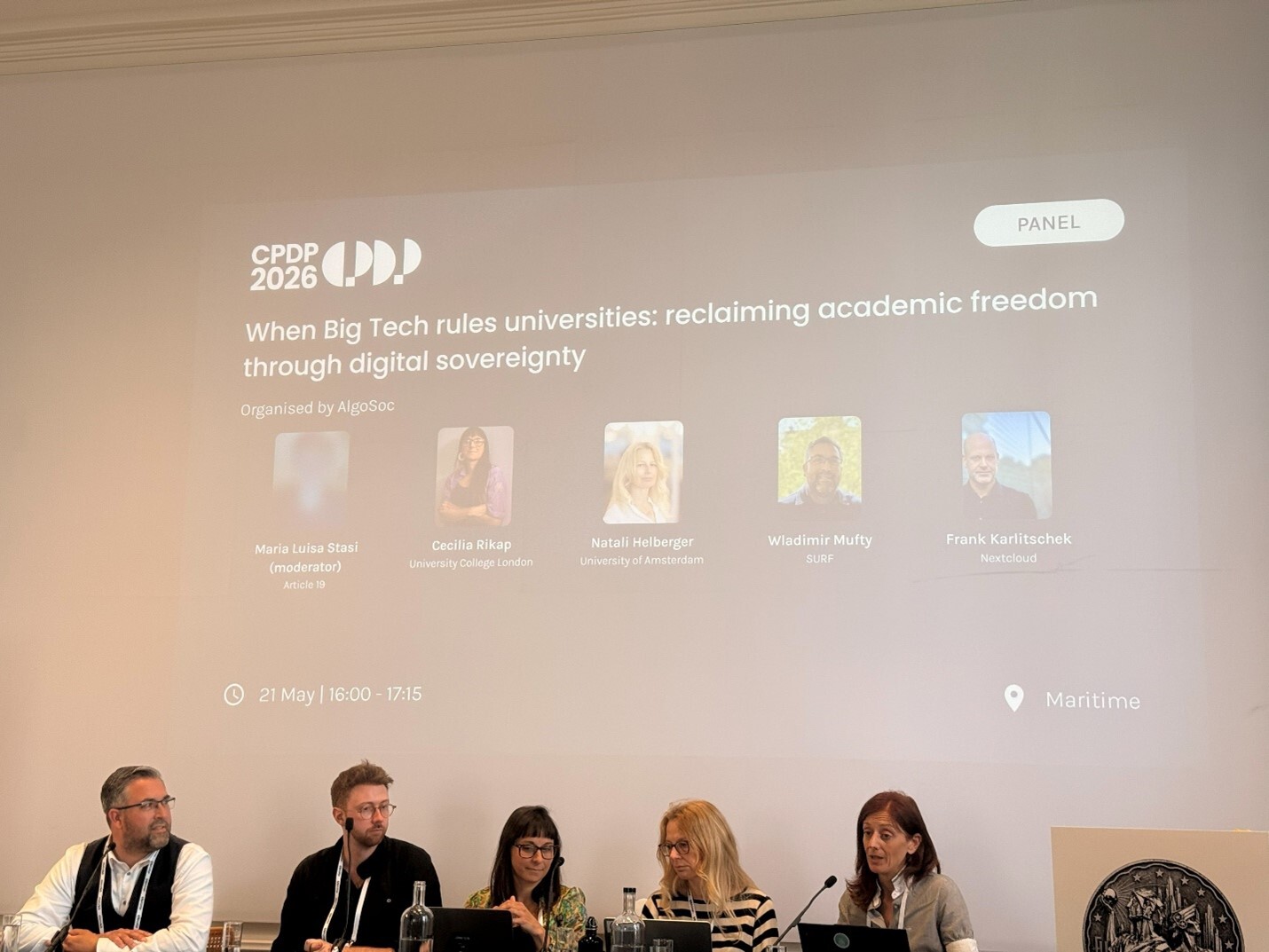
Digital infrastructures are essential resources enabling research and education. Now, however, universities that have long made themselves dependent on cloud services provided by Big Tech are additionally incorporating a variety of AI-tools that it offers. This not only comes with risks to privacy, data protection, and security, but also threatens the very core of universities – academic freedom.
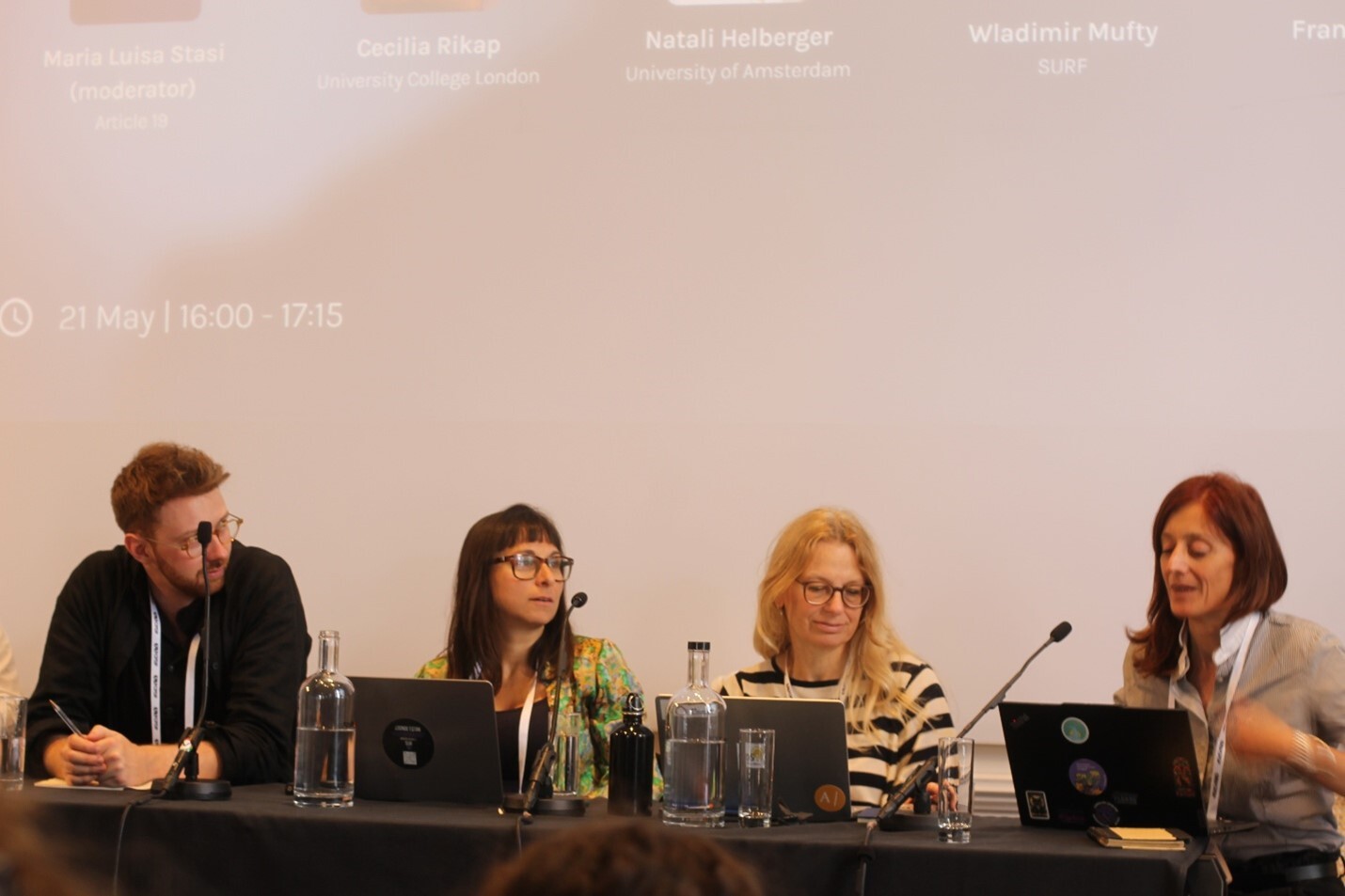
During the CPDP Conference, the AlgoSoc panel “When Big Tech Rules Universities: Reclaiming Academic Freedom Through Digital Sovereignty”, Maria Luisa Stasi, Natali Helberger, Cecilia Rikap, Wladimir Mufty and Michael Veale discussed what this growing dependence on large technology companies means for universities.
Firstly, such freedom, next to the scientific advancements and institutional autonomy may fall victim of changes in transatlantic relations. Secondly, though less manifestly, academia may become shaped by peculiar economic rather than public values underlying research integrity. At this CPDP panel, researchers and practitioners examined how universities' growing dependence on a small number of large technology companies is quietly reshaping academic freedom — not just in terms of research outputs, but in the very infrastructures and tools that make research possible. We considered whether the use of alternative research infrastructures by universities is feasible and can preserve universities’ independence as a prerequisite for academic freedom in the age of AI and cloud computing.
Maria Luisa Stasi opened the panel with a reminder that academic autonomy is not an academic hobby horse, but benefits and serves society as a whole. Explaining why academic autonomy is so important, Cecilia Rikap warned that the commodification of knowledge is accelerating, with Big Tech firms appropriating and patenting research outputs while universities and academics increasingly pay to access the results of their own work. Digging deep into the roots of the problem, Michael Veale observed that organisations are expected to adapt to the technology, rather than technology adapting to the organisation. He called for universities to imagine how technology should look like, instead of simply adapting to dominant platform models. Natali Helberger then shared her experience from the AlgoSoc Nextcloud pilot and some of the key drivers that helped with our transition, including at the level of researchers: a joint momentum and keeping the bigger picture alive, at the level of the university: an organisational culture of thinking in terms of solutions, not problems and investment in technical support and feedback loops, at the level of policy makers: simpler procedures and dedicated funding for public interest pilots, public procurement and legal obligations for large technology companies to cooperate. The importance of co-operation was reinforced by Wladimir Mufty who called to action and explained that giving some autonomy away as part of such cooperations can lead to more autonomy vis-à-vis large tech vendors.
The panel agreed that algorithms are not neutral tools but mechanisms of governance: if universities do not govern the algorithms they adopt, those who design them will effectively govern universities. Speakers called for a fundamental shift in narrative — away from Big Tech's logic of convenience and cost, and towards a model in which universities collectively reclaim control over their digital environments and research agendas.
The key takeaway was clear: this is a collective challenge requiring collective action, political will, and a willingness to invest in the difficult but necessary work of building genuinely independent academic infrastructures.
Author

Media / Sector Leader
Prof. dr. Natali Helberger
Distuingished university professor of law and digital technology with a special emphasis on artificial intelligence / University of Amsterdam
University ProfileSee also

Shared responsibility, unequal power: Mapping the limitations of multi-stakeholderism in the EU’s digital governance
By Charis Papaevangelou • Sabrina Kutscher • Natali Helberger • José van Dijck • Thomas Poell • June 01, 2026

Cloud drift: how hyperscaler cloud computing shapes internet governance
By Corinne Cath • May 29, 2026

“Reliable and cheap”?: Examining the adoption of the cloud by European news media companies
By Agustin Ferrari Braun • May 08, 2026


Hou DigiD uit Amerikaanse handen nu het nog kan
By José van Dijck • April 30, 2026
More results /
 The 2026 Stevin Prize: Claes de Vreese and his academic journey
By Claes de Vreese • October 07, 2026
By Ernesto de León • Claes de Vreese • September 17, 2026
By Natali Helberger • June 16, 2026
 Onderzoekers waarschuwen: AI-gebruik kan ‘rechterlijke blik’ vertroebelen
By Iris van Domselaar • Isabella Banks • October 01, 2026
By Iris van Domselaar • Isabella Banks • September 23, 2026
By Tynke Schepers • July 09, 2026
 Fairy Tales That Make Life Harder: AI, and the social and ethical costs of believing in it
By Martijn Logtenberg • September 28, 2026
By Martijn Logtenberg • March 13, 2026
By Martijn Logtenberg • November 20, 2025
 The Label Paradox: Can AI transparency create more distrust?
By Natali Helberger • September 21, 2026
By Jin Wan • Theo Araujo • Natali Helberger • Claes de Vreese • September 17, 2026
By João Pedro Quintais • September 03, 2026
