July 09, 2026
Beyond the AI hype: Reflections on the AI-Radar 2026 and the future of AI in the justice sector
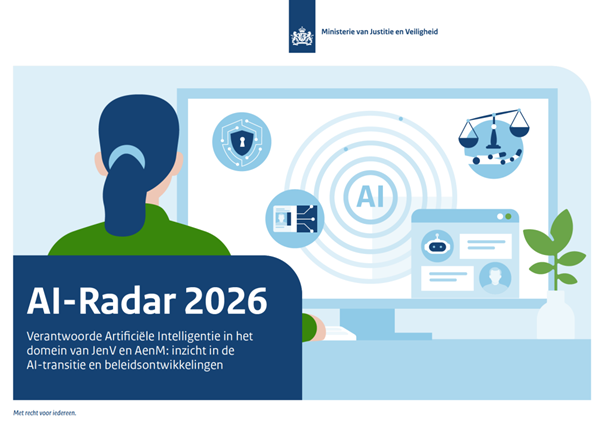
On the 29th of June, 2026, AlgoSoc hosted an interactive online roundtable on the recently published AI-Radar by the Dutch Ministry of Justice and Security (JenV). The purpose of the AI-Radar is to gain insight into the current state of and impact on the Ministry, while taking rapid developments (both nationally and internationally) into account. The AI-Radar will serve as the basis for a broader AI strategy and policy development at the Ministry. With the current developments of more advanced models and restrictions from foreign governments on what models can be used, this discussion was a very welcome moment of reflection on the way forward.
The AI-Radar
The presenters at the roundtable each brought unique perspectives and experiences, allowing the discussion to integrate diverse points of view. The discussion was moderated by Iris van Domselaar, Professor of Legal Philosophy and Legal Ethics at the UvA, and was kicked off by a brief presentation from Natalie Koot and Emma Zwart, employees of the Ministry of Justice and Security who worked on the AI-Radar. The AI-Radar, as they explained, is an opportunity to give insight in the current AI developments and their impact on the Ministry and the different organisations within the justice and security domain. Instead of reacting to technological developments, the aim is to be proactive and embed technology responsibly across the different organisations in the justice sector.
Although the AI-Radar identifies six key findings, the discussion focused on three findings in particular, which Emma Zwart briefly highlighted at the beginning of the session. The first focused on the fact that citizens support the use of algorithmic systems and AI by the Ministries of Justice and Security, and Asylum and Migration, though they become more critical when these technologies have a direct impact on their own lives. The second key finding examined AI experiments within the ministry (of which there are many!) but showed that scaling up experiments into operational applications with proven value remains a challenge. The knowledge and capacity are present at the Ministry, but can be used and exchanged with other partners more systematically. The third and final key finding for the discussion focused on recent (EU) legislation for AI. Some of the legislation still needs to be implemented, though some already existing legislation needs to be updated where necessary. The aim of the session, according to Natalie Koot and Emma Zwart, was clear: to keep the conversation on the use of AI in the justice sector going and to exchange perspectives and ideas on the way forward.
Impact of AI on organisations
The second presenter, who reflected on the AI-Radar, was Jos Smits, program manager AI at the Judiciary. The Judiciary has recently also published an AI strategy, and Jos Smits summarised the two main challenges as follows. First, they aim to realise AI applications for both the judiciary and those seeking justice. Second, they look for ways to increase the justice sector’s resilience to society's use of AI. There was quite a bit of overlap between the AI-Radar and the judiciary’s AI strategy, starting with the current hyping of the technology and the fact that experiments do not always make it past the initial phase. Jos Smits compared AI applications to a children’s toy: AI is seen as a new and exciting tool that can be used to address a number of issues, yet the question often starts with AI and ends with finding an appropriate application for ‘the new toy’. This makes it even more relevant to focus on cases where AI applications have added and proven value, rather than just deploying technology for technology’s sake.
Creating resilience in the justice system also depends, to a large degree, on employees' AI literacy. Although many who think about AI literacy focus on how employees can use certain tools, Jos Smits argued that we need to train people to work with those who use AI tools. As an example, Jos Smits referred to recent media reports that the use of AI by those seeking justice or access to other government services has increased exponentially, which increases the work pressure on civil servants, as these models often hallucinate or include arguments that are not relevant to the particular case. The proposed solution lies not only in legislation but also in changing the revenue models, which is often not part of the conversation.
AI as an opportunity for government
AI can also have benefits for government, argued Luc Verhey, counsellor at the Council of State and Professor of Constitutional Law and Administrative Law (Leiden University), as it can help increase government efficiency and capacity. Especially as citizens demand more from the government, AI applications can help deliver. Luc Verhey mentioned that we need to be careful about where these applications come from: it is important to work with applications that align with our democratic values, that we can influence if we see they are not working correctly, and that are transparent. Emma Zwart and Natalie Koot agreed and stated that, given the rapid developments in this area, ensuring adequate and timely reporting is and will remain a key priority for JenV.
Another central point in Luc Verhey’s presentation focused on the quality of legislation, especially for the Ministry of Justice and Security, as the Minister is responsible for the quality of legislation. This means that legislation needs to be lawful, understandable, not have unintended consequences, and be easy for state organs, judges and citizens to apply. At the moment there are numerous examples of initiatives aimed at making legislation (especially EU legislation) less complex. Yet legislation remains an important legal safeguard that protects human rights, the legal principles of legal certainty and equality before the law and allows for democratic control. The current economic focus on deregulation, as seen in the Draghi report, offers a different perspective yet also puts a finger on the sore spot: there currently is a lot of legal complexity, due to different layers of legislation and/or how certain legislation relates to other legislation. Additionally, agencies, regulators and ministries design policy rules and policy instruments, and, in doing so, create a maze of compliance and bureaucracy, which adds a further burden on organisations in the justice sector. This then also leads to Luc Verhey’s conclusion: the plea for a broader approach to legislation and the use of AI, rather than a mere economic focus on efficiency.
An academic perspective
The third and final speaker, Shirley Kempeneer, Assistant Professor of Digital Governance at Tilburg University, took the time to look forward: where do we want to go with an AI strategy, and what do we need to consider to get there? In her presentation, she focused on three key points. The first focused on the use of AI as ‘a children’s toy’, echoing Jos Smits in saying that we need to focus on concrete examples of where AI adds value. While this is already present in the AI-Radar, it would be beneficial to highlight it further. A second point focused on AI literacy, where the focus should not only be on technical knowledge but also on ‘de-hyping’ AI and algorithmic systems. Shirley called this the ‘magic AI sauce’, stating that AI is often seen as a magical solution to whatever problem the organisation is facing. A third point, in line with the focus on AI literacy, asked whether we want to focus on AI as a thing in itself or on the issues we want to solve (with or without AI). After all, as Shirley Kempeneer argued, the main issue is whether processes can be improved with algorithmic systems, not just by deploying AI or algorithms.
On a more academic note, Shirley Kempeneer focused on what is called ‘technology enactment’: AI (or any technical system) is embedded within an organisation, and that embedding is what gives the technology meaning. Institutional factors such as norms, values, perceptions, policies, and regulations shape the use of the technology within the organisation. It is not only about the technology itself, but also about the way it is interpreted, translated into the particular context, and operationalised, which gives it added value. Bringing this back to the AI-Radar, Shirley Kempeneer noted that it is important to see the document as a valuable starting point and build on it from there, with a focus on processes and on how and for what purpose the ministry wants to implement and embed the technology in the organisation.
Next steps for policy
Natalie Koot and Emma Zwart mentioned that a lot of the points raised during the session mirrored internal discussions – for example, the issue of AI literacy (knowing what AI can do and what it cannot do) was already placed on the agenda and informed some of the next steps mentioned in the document, such as new courses for civil servants on the usage and impact of AI.
Another method to engage civil servants into thinking about the impact of AI on their field of work was the organisation of an ideathon. Although this can be criticised as overly optimistic, since civil servants are encouraged to ‘think without restrictions’, it also provides a way to identify opportunities and facilitate discussions between AI-optimists and AI-pessimists within the organisation. Finding a balanced approach to the AI hype remains a challenge.
The roundtable concluded with a plea for multidisciplinarity at all levels of an organisation: at higher levels, where decisions are made on the implementation of AI or algorithmic systems, technical knowledge is often lacking. AI is often seen as only a language model, even though the technology can do much more. Here, Natalie Koot and Emma Zwart were able to share that this is a current point of development at the Ministry: not only is the central Dutch Digitalisation Strategy (Nederlandse Digitaliseringsstrategie) facilitating these conversations, but also within the Ministry, expert teams and knowledge exchange are gaining more and more attention.

Author

See also
When Big Tech rules universities: Reclaiming academic freedom through digital sovereignty
By Natali Helberger • June 16, 2026

Understanding AI transparency
By Natali Helberger • Marilù Miotto • March 09, 2026


De AI-industrie buit mens en aarde uit
By Roel Dobbe • November 24, 2025

Governments want to ease AI regulation for innovation, but do citizens agree?
By Natali Helberger • Claes de Vreese • July 31, 2025
More results /
 The 2026 Stevin Prize: Claes de Vreese and his academic journey
By Claes de Vreese • October 07, 2026
By Ernesto de León • Claes de Vreese • September 17, 2026
By Natali Helberger • June 16, 2026
 Onderzoekers waarschuwen: AI-gebruik kan ‘rechterlijke blik’ vertroebelen
By Iris van Domselaar • Isabella Banks • October 01, 2026
By Iris van Domselaar • Isabella Banks • September 23, 2026
By Tynke Schepers • July 09, 2026
 Fairy Tales That Make Life Harder: AI, and the social and ethical costs of believing in it
By Martijn Logtenberg • September 28, 2026
By Martijn Logtenberg • March 13, 2026
By Martijn Logtenberg • November 20, 2025
 The Label Paradox: Can AI transparency create more distrust?
By Natali Helberger • September 21, 2026
By Jin Wan • Theo Araujo • Natali Helberger • Claes de Vreese • September 17, 2026
By João Pedro Quintais • September 03, 2026
