September 17, 2026
AI insiders warn it could end humanity. Does the public agree?
Artificial intelligence is becoming an increasingly visible part of everyday life, public debate and political decision-making. Yet public views of these technologies remain far from uniform: alongside expectations of progress and convenience are concerns about control, inequality, misinformation and more fundamental societal risks.
Last week, researchers at Anthropic and OpenAI warned publicly that AI could wipe out humanity, with one putting the risk at more than 10% within a decade. The CEOs of both companies called for a slowdown, while critics suggest these doomsday warnings mainly generate hype, attract investment and push for regulation that suits the companies.
But does the public share this fear?
Public opinion matters in this debate: how citizens see the risks of AI shapes the political room governments have to regulate these technologies that could supposedly end the human race. Lucky for all of us, the AlgoSoc panel has been following the same group of Dutch adults for three years, asking about precisely these perceptions.
A public split down the middle
First, we paint a broader picture of people’s general attitudes towards AI. We asked a representative sample of the Dutch population six questions on feelings about, expectations of and preferences for AI, combined into a single attitude score based on previous academic work.
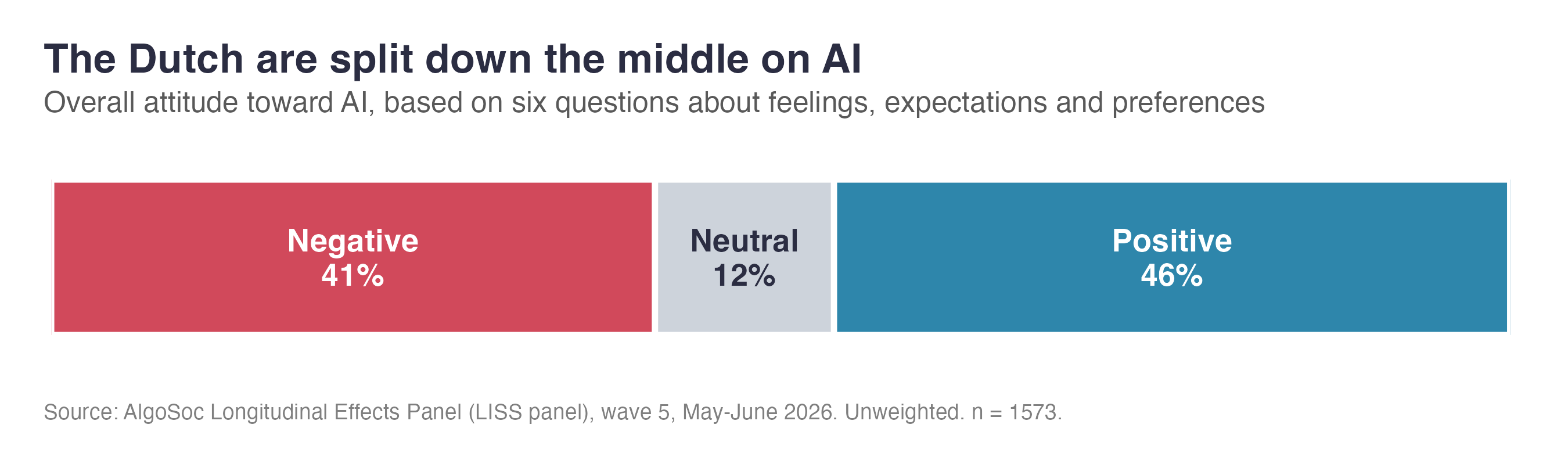
We see a somewhat surprising split: 46% lean positive, 41% lean negative and 12% sit in the middle. This split was stable compared with our previous round. Despite the intense hype around AI, the public has neither been completely swept up in enthusiasm nor turned against it as a whole.
Is AI a threat to humanity?
People with a negative view of AI got a follow-up question: to what extent do you believe AI is a threat to the survival of humanity?
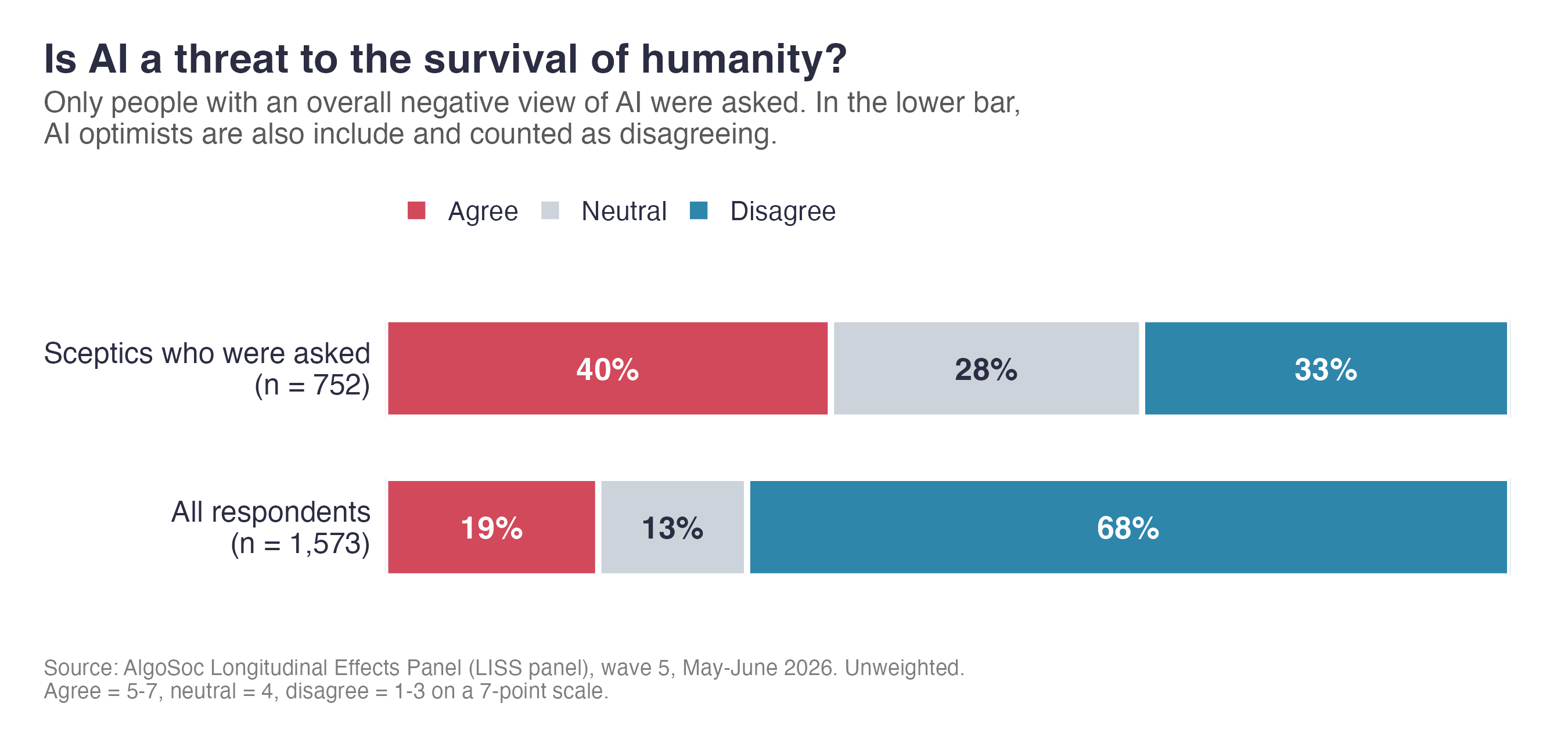
Among these sceptics, 40% agree that AI threatens humanity’s survival. Another 28% are unsure and 33% disagree.
Across the whole population, that comes to at least one in five Dutch adults (19%).
That is quite a striking number, and means that even before last week’s warnings, a substantial share of the public already took seriously a scenario that until recently seemed like science fiction.
Who is worried?
The concern about AI leading to the extinction of humanity is not spread evenly.
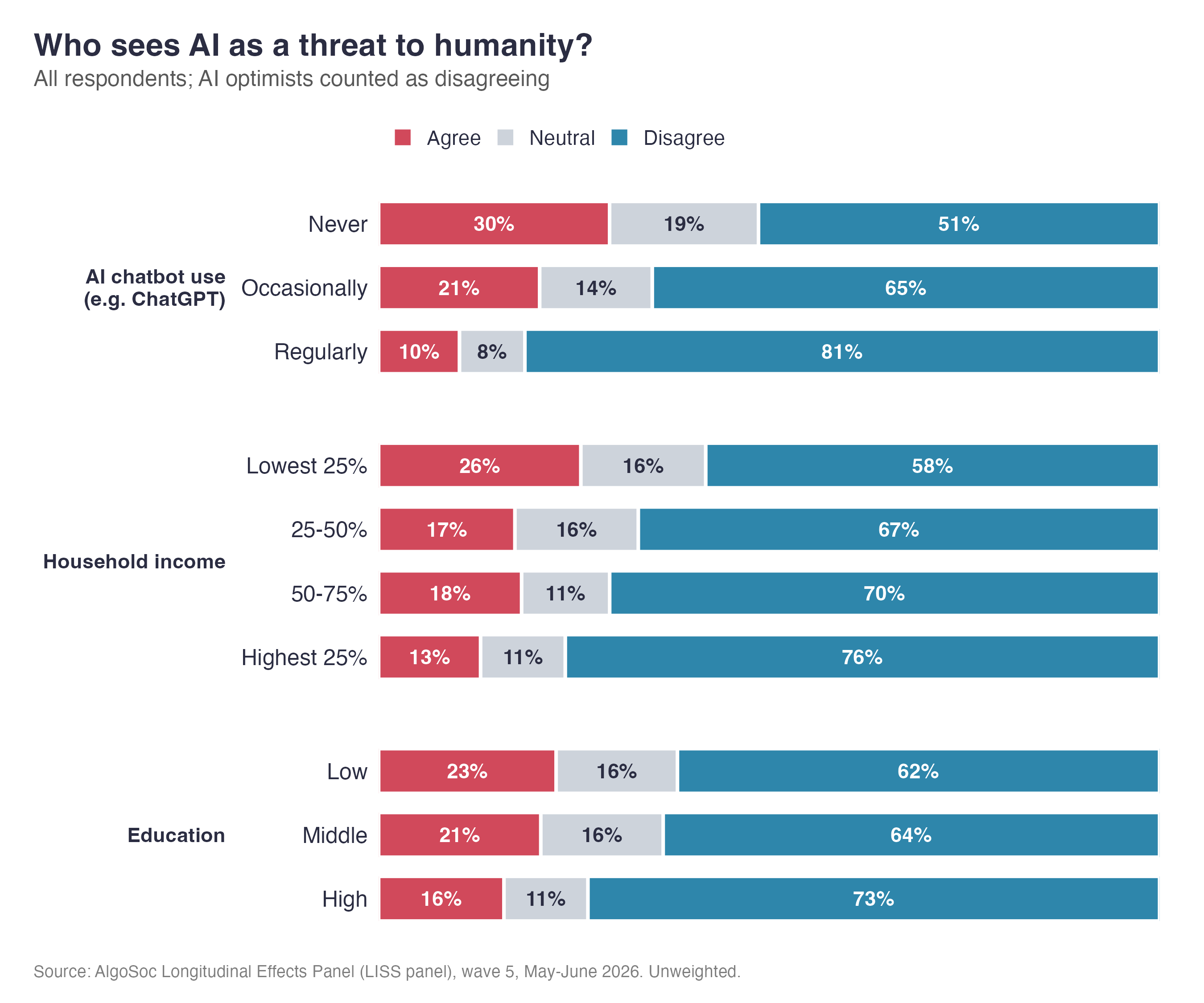
The biggest difference is experience with AI. Among people who have never used a chatbot like ChatGPT, 30% see AI as a threat to humanity, while among regular users, the number is a third of that: only 10%. This is largely because sceptics tend not to use AI: 63% of non-users have a negative view of AI, compared with 21% of regular users. Among sceptics themselves, around four in ten see AI as a threat whether they use chatbots or not.
Income and education show a similar but weaker pattern: concerns that AI could wipe out humanity decrease with higher income and education.
What we can and can’t say yet
These findings describe public opinion before last week (May and June of 2026), not how people are reacting now. Existential warnings used to come from science fiction and a handful of researchers; now they come from inside the companies building the technology. These warnings are being communicated to a public where the worry already exists. Whether they deepen it is an open question.
We will know more soon: in October, we will ask the same people the same questions again. Because we follow the same individuals, we can test whether warnings from inside the AI industry shift public opinion, or whether it is more stable than the headlines suggest.
Want to learn more? At AlgoSoc we have created the AI Public Opinion monitor, a handy dashboard that allows anyone to explore years of public opinion data surrounding algorithms and AI. Check it out!
Authors


Media / Sector Leader
Prof. dr. Claes de Vreese
Distinguished university professor of artificial intelligence and society with a special focus on media and democracy / University of Amsterdam
University ProfileSee also

De AI-industrie buit mens en aarde uit
By Roel Dobbe • November 24, 2025

Help onze democratie stutten tegen de stormvloed die techoligarchen gecreëerd hebben
By Roel Dobbe • November 12, 2025
1 in 10 Dutch citizens are likely to ask AI for election advice. This is why they shouldn't
By Ernesto de León • Fabio Votta • Theo Araujo • Claes de Vreese • October 28, 2025
More results /
 The 2026 Stevin Prize: Claes de Vreese and his academic journey
By Claes de Vreese • October 07, 2026
By Ernesto de León • Claes de Vreese • September 17, 2026
By Natali Helberger • June 16, 2026
 Onderzoekers waarschuwen: AI-gebruik kan ‘rechterlijke blik’ vertroebelen
By Iris van Domselaar • Isabella Banks • October 01, 2026
By Iris van Domselaar • Isabella Banks • September 23, 2026
By Tynke Schepers • July 09, 2026
 Fairy Tales That Make Life Harder: AI, and the social and ethical costs of believing in it
By Martijn Logtenberg • September 28, 2026
By Martijn Logtenberg • March 13, 2026
By Martijn Logtenberg • November 20, 2025
 The Label Paradox: Can AI transparency create more distrust?
By Natali Helberger • September 21, 2026
By Jin Wan • Theo Araujo • Natali Helberger • Claes de Vreese • September 17, 2026
By João Pedro Quintais • September 03, 2026
