September 28, 2026
Fairy Tales That Make Life Harder: AI, and the social and ethical costs of believing in it
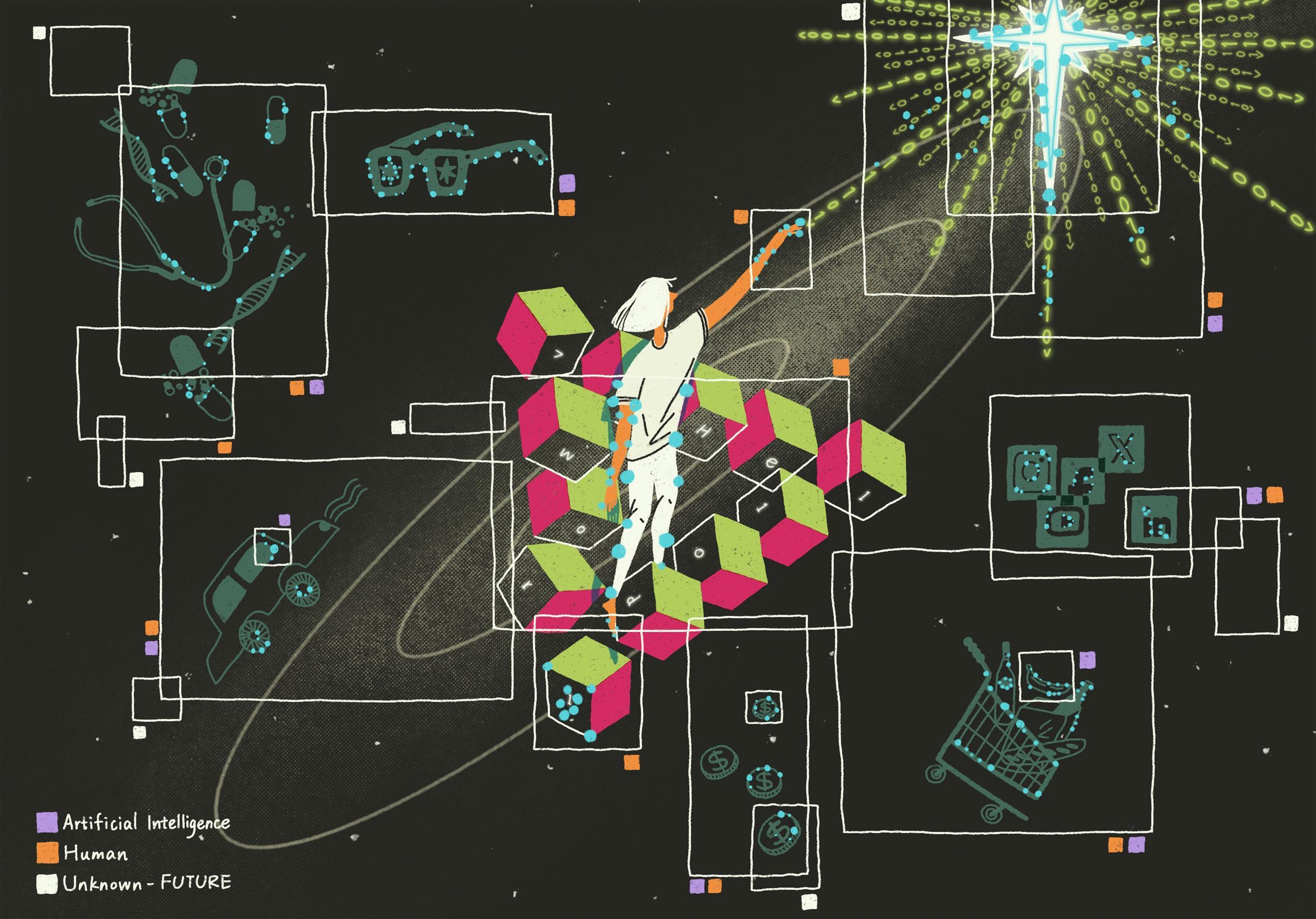
The following is a keynote given by Martijn Logtenberg on 28 September during a joint women's network event in Cologne. Sources are referred to through hyperlinks.
About once a week, someone tells me I picked a very relevant specialization. AI does seem to be everywhere: in the media, with yet another new model; in politics, as a source of fear about dependency; in the services we use, when Google adds an AI summary to my search; at work, where ChatGPT increasingly dominates, and in the growing number of discussions about how to navigate all of this. At my own university we struggle too: we want students to learn to write, but how do we know if something wasn't AI-generated? Should we even try, given that AI is supposedly the future anyway?
It is hard to ignore that the era of AI has arrived; that it is something to live with and govern, not something to fight. Or is it?
Much of my own research focuses on healthcare, so many of my examples will come from there but I see these same trends everywhere.
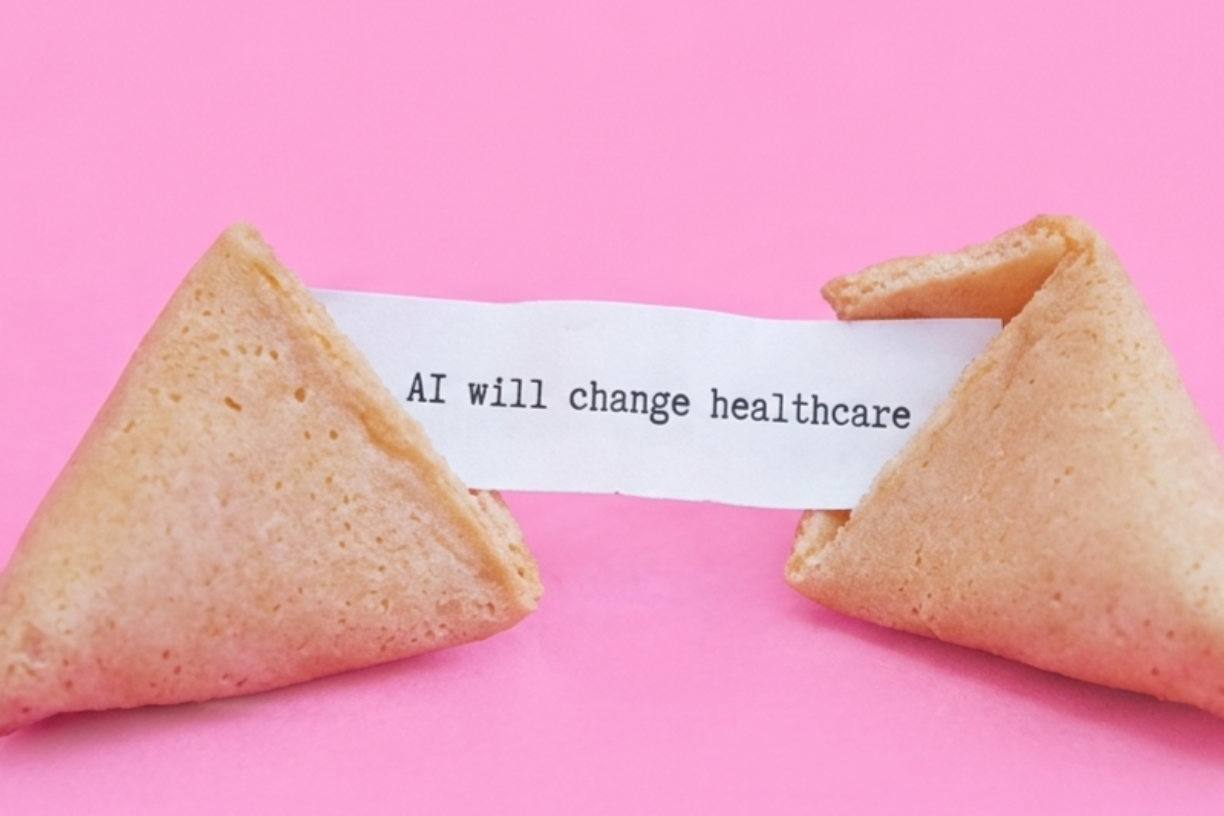
I want to start with healthcare, though, because frankly there is little evidence that AI is actually being adopted or having meaningful effects. Castonguay and colleagues classify Germany, like almost every other OECD country, as a Class 2, or “Emerging,” country: they recognize AI, they pay for it, but it has not yielded much benefit. The usual response is that more is needed: more funding, more government support, often fewer regulations, and more hours from clinical staff already stretched thin. Notice that these are organizational changes, not technical ones. That already makes AI a social problem before it is a technical one.
The same goes for businesses: massive amounts of investment have been made, but little of this has translated into returns. An aggregated report combining multiple surveys shows that 69% of firms say they are using AI but only 11% say they have a measurable impact on productivity.
Meanwhile, investment flows have been staggering. Many people have, as a result, called this a hype bubble. boyd and Crawford noted that this hype rests on the idea that AI is objective; that because it runs on massive amounts of data, it must give a more truthful answer. Because something is an algorithm, we assume it is objective, and we don't look much further. Kampmann described it as a fetishization of AI: more unicorn start-ups and Big Tech companies “AI-washing” their way forward, until the promises break down and the company collapses financially. We see this happen unfortunately regularly.
I think this belief in AI is the real problem.
Now, you might think the blame for these high expectations lies with Big Tech companies, and the literature would largely agree: Big Tech imposes large expectations and sells a myth of transformation in order to earn money. Borrowing from Brown and Michael we would say they are “colonizing our future.” We also see these effects more and more with unrest around the Hugging Face hack that has Anthropic and OpenAI calling for a slow-down: regulation, standards. My read is that while AI can be unsafe if you allow it to roam free, not put down any guardrails, consistently lobby against government regulation, only to then publicly announce the opposite. I don’t think that is philanthropy, I think it’s called marketing.
Still, I think that blaming Big Tech for all the hype is a little short-sighted. Future studies has increasingly embraced the idea that how we imagine the future has less to do with how likely that future actually is, and more to do with which narratives are available to us; Vicsek and Pinter studied this recently. These narrative templates are made up of metaphors and stories from popular media, from algorithmically filtered content, but also from institutions we trust: our own governments, our own newspapers. Breuer and Muller analysed German policy documents and found AI consistently promised as the solution to the healthcare crisis, which in turn makes the underlying problems easier to downplay.
Brause found the same pattern across German media, which is somewhat surprising, since Germany is usually more hesitant toward emerging technologies. Even the European Commission does this, as Rieder shows. All of it pushes us toward one of two stories: a dystopian future in which AI takes our jobs and takes over the world, or a utopia in which AI solves all our societal problems.
THE COMFORT OF NO TRADE-OFFS: Why We Want to Believe It
Especially where we see problems, our instinct is to look for solutions that avoid any trade-off. Healthcare is a very good example of this. Understaffed, with ever-increasing costs, healthcare threatens the welfare state as we know it. It would be very convenient to find a solution that doesn't require us to pay significantly more in taxes, restructure our education system to train more healthcare workers, or cut back on the care we deliver. And then AI arrives: a term vague enough that we can believe we can have it both ways: innovation without any real, difficult change.
This belief has real effects. The last Dutch cabinet committed 800 million euros to AI in healthcare. Not based on evidence, but on the belief that AI could halve administrative work by 2030. The minister responsible, Agema, acknowledged as much herself: she would have preferred structural funding, but could only secure it once she could prove the technology worked. She couldn't, because it's still too early.
Bory and colleagues describe this pattern well: policy documents dealing with AI, especially early in the policy-making process, tend to make sweeping assumptions and broad claims, routinely positioning AI as a powerful, external force.
“One early draft report from the European Parliament’s Special Committee on AI in a Digital Age described AI as “the fifth element after air, earth, water and fire.” US president Donald Trump, at the 2018 White House Summit on AI, said much the same: “We stand at the birth of a new millennium, ready to unlock the mysteries of space, to free the Earth from the miseries of disease, and to harness the energies, industries and technologies of tomorrow.”” — (Bory and colleagues)
We laugh at that kind of language. But we build 800-million-euro budgets on the same logic.
These beliefs obviously aren't free of interests. I found the same in my own research on healthcare start-ups: expected to be innovative, and then left to manage the resulting hype gap to avoid disappointment, much like the quote below describes.
“I visit a conference panel named “Smoke & Mirrors: How Investors Pick Winners in Healthcare AI”. One investor used the metaphor of “organ rejection,” arguing that founders often try to change too much, too quickly, only to be rejected by the healthcare system. Yet by the end of the panel, investors envisioned a future of autonomous treatments, AI-driven diagnoses, and robots outnumbering healthcare professionals.” — (Fieldnotes)
The literature on hype confirms this: we don't necessarily believe the hype, but we participate in it anyway. In the end, it barely matters whether we believe it, as long as we act as if we do.
INCENTIVES: Who Has an Incentive?
A question worth asking is: who benefits from this? Investors often have an incentive to fuel the hype, since it raises the value of their exit. Politicians like pushing AI because it makes them look like they're solving a problem, for example Kostler and Ossewaarde note that the German government uses AI visions to reinforce the status quo, precisely by keeping AI vague. Media is rewarded for painting a skewed picture of AI, in either direction. Individuals within organizations often need momentum behind a project to get organizational support, so they oversell it.
Academics — myself included — are not exempt from this. We all participate in the same balancing act. De Togni describes it well: participate in the hype, while claiming to be the nuanced one standing outside it. The result is a debate that keeps losing its nuance, while the underlying conundrum remains: we trust a myth of objectivity, without noticing that the reality is usually simply disappointing.
None of this would actually be a problem if it were just a comforting fairy tale. But I think it leads to two real consequences: overreliance, and a set of costs that this belief tends to obscure.
CONSEQUENCE ONE: Overreliance in Misleading Tech
When people don't critically interrogate a system, they don't see the human work behind the technology. Kempeneer and Heylen found that salespeople and data scientists often can't explain the technical details themselves but that this inexplicable nature is exactly what gives them the power to sell the technology as a miracle solution. At the same time, a lot of research is being done on the human work that goes into AI. Semel, for example, describes how people who annotate data enter a mode she calls “listening like a computer.” Henriksen and Bechmann show how data scientists try to “build new truths” with AI in a reality that is far too messy for that — and, as other work shows, annotators often disagree with each other about what the “right” label even is. Stevens draws attention to the negotiations between data scientists and practitioners over what even counts as knowledge. The objective truth AI promises us clearly has many sides and, as Akrich famously argued back in 1992, developers inscribe their own particular visions of users and their worlds into the technology itself. Whose incentives shape the system matters.
This doesn't stop at the design phase. In healthcare, we often see the same pattern: we introduce an algorithm and expect professionals to simply change their behaviour. It doesn't work like that. Jussupow calls the behaviour she observes in doctors “meta-cognitions”: they don't just evaluate what they think is the right decision, but then evaluate that decision again relative to what the algorithm says. This means we often don't see the efficiency gains we hoped for, and — because humans aren't very good at this kind of second-guessing — the quality gains tend to be negligible too. This isn't rare: Maiers found the same among nurses in the neonatal unit, and Carboni found it among psychiatrists.
What does change is two things. First, we see shifts in power structures, usually ones that reinforce the existing hierarchy. Elish and Watkins studied a sepsis algorithm and found that nurses had to chase down doctors to flag cases, speak up against them, and manually piece together what the algorithm's output actually meant. Second, the mere promise of a technology changes how people work, even before it arrives. Carboni shows that healthcare professionals begin anticipating and adapting to innovations well before those innovations are actually in use; adjusting their workflows, expectations, and mental models around what they've been told is coming. Stevens found that professionals flexibly imagine a technology, moulding it to their own needs in their heads. The disappointment comes when the real product arrives and can't live up to that imagined flexibility. In these small ways, we make people's lives unnecessarily harder.
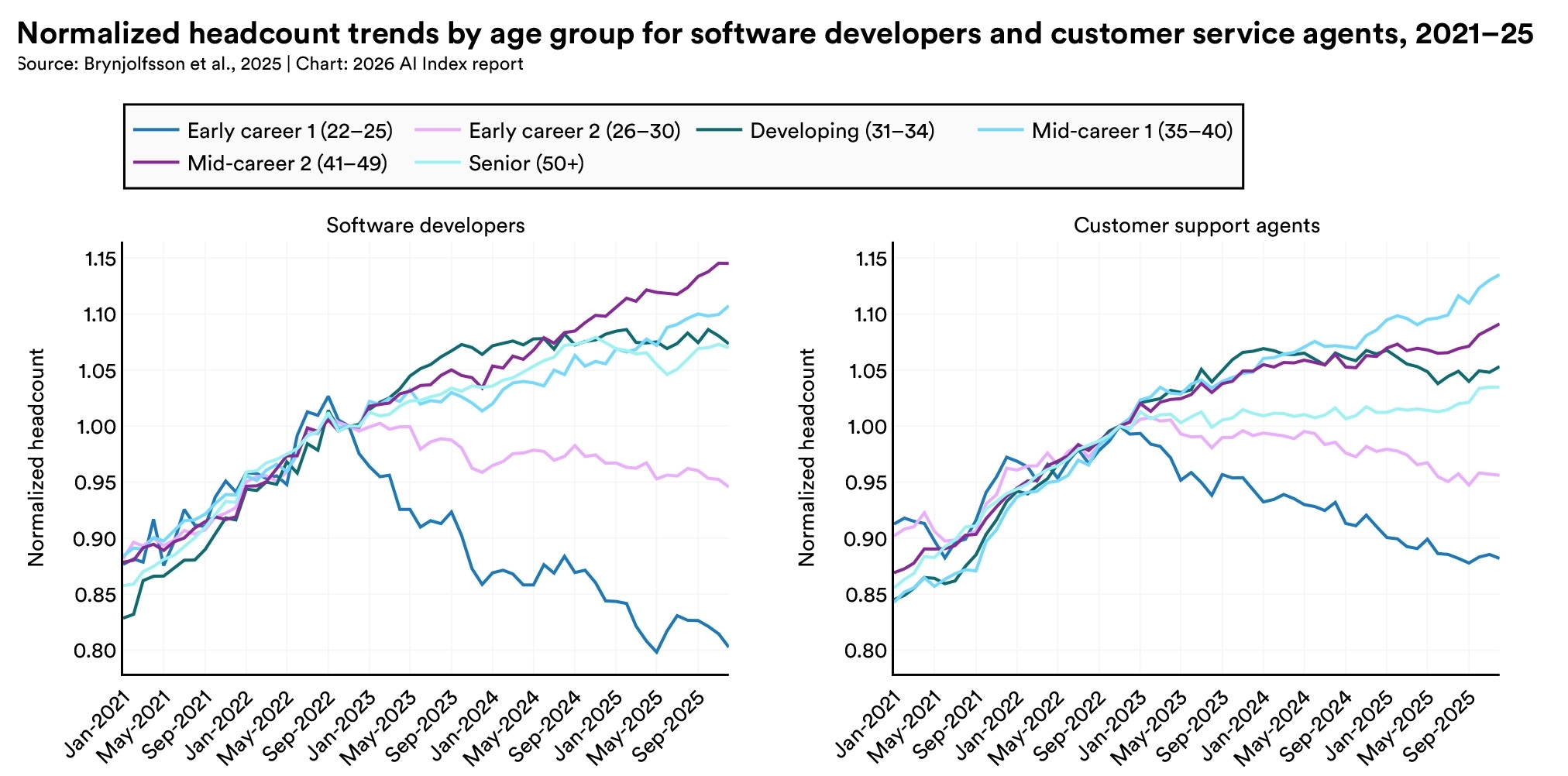
On a broader level, the picture becomes more troubling. Our belief in AI has also meant that we've pre-emptively slowed down hiring young people. Stouffer calls this the “broken ladder”: researchers have found a 16 percent decline in entry-level employment among young people in the US. And the jobs that do remain are increasingly structured by algorithms, often not for the better. For example, Gent's book Cyberboss documents how, for Amazon workers or Uber drivers, algorithms push people harder by gamifying their work or denying them bathroom breaks. Algorithmic surveillance is also becoming more common outside the workplace: Galic's work on smart cities shows how AI-driven urban infrastructure slowly turns cities into spaces of mass surveillance.
Beyond that, the belief that AI is paramount has meant investments have skyrocketed. 600 billion dollars have gone into data scientists and infrastructure in 2025 only, to the point that even the IMF now names it as a risk. When a bubble this size pops, economic downturn tends to follow.
And lastly — something we tend to forget — we do have real problems in society, and if we keep reaching for AI as the answer to all of them, we stop focusing on solving them in other ways. This crowds out ideas and debates we should be having. This kind of technosolutionism isn't new, but it's worth not forgetting. One example comes from personal experience: during the COVID crisis, I was the national coordinator of contact-tracing research. COVID trackers promised to help overburdened contact tracers who, at certain points, simply couldn't keep up with the scale of the pandemic. But as Siffels and Sharon describe, these trackers shifted purpose during development; first meant to make contact tracing faster, then to increase the number of contacts traced. Those aren't the same goal, and it's a familiar pattern in data science. In the meantime, we spent real money and precious time believing the solution for overworked contact tracers would come from technology. In the end, it never did.
CONSEQUENCE TWO: The Costs That Get Lost in the Myth
This overreliance is really just the tip of the iceberg. AI has many costs, and it's hard to fully capture the extent of the harm, but I want to flag a few that are close to my heart.
First, people tend to think AI lives in the cloud. In reality, it lives in a data centre; for instance, one in Greece, where Papaevangelou showed how Microsoft actively lobbied its way into national infrastructure, with real, detrimental effects on the local climate and communities. Velkola and Plantin argue that data centres capitalise on their local environment: they require massive amounts of water for cooling, and so much energy that they can block the local grid from being used for anything else.
Second, people tend to think AI is just something on their computer, forgetting that it runs on infrastructure owned by Big Tech companies. That's a real threat to our autonomy. Cath, in her short book Eaten by the Internet, describes the power that comes with owning that infrastructure, over discourse, economics, politics, and privacy. Microsoft, Google, and Amazon have that power. A concrete example: in the Netherlands, a prosecutor from the ICC was blocked from accessing Microsoft services following US sanctions on the ICC. Digital autonomy has recently gained more political attention, but we shouldn't lose sight of it or underestimate the quieter loss of autonomy that comes with using ChatGPT, or cloud services more generally.
Third, people tend to think AI is more neutral. Regrettably, it isn't — far from it. I hope I've already made the case for how much subjective work goes into building these tools, but if not, I'd recommend O'Neil's Weapons of Math Destruction, which shows how data collected in a discriminatory society ends up perpetuating that discrimination further. We know this cost well here in the Netherlands: thousands of families were denied tens of thousands of euros in childcare benefits because an algorithm judged them to be fraudulent. It turned out the algorithm was wrong in many cases, and those affected often simply had a foreign-sounding surname.
And lastly, there are direct harmful uses. The most prominent are deepfakes, where algorithms have become realistic enough to generate sexual content of an ex-partner or a stranger, based on a single photo. Politically, they're useful too: cheap to generate and often effective at scaring people. In the last Bundestag election in 2025, Votta showed that parties like the AfD commonly used this technique, and in Romania we've seen that algorithmic manipulation can meaningfully influence election outcomes.
There are more harms I don't have time to cover today — copyright infringement, military use, use in immigration enforcement. I hope this talk is reason enough for you to keep considering them.
CLOSING: Who Has an Incentive to Shape My Expectations?
If there's one thing I want you to take from today, it's that our expectations about AI are not neutral, and that they are dangerous, because they tend to obscure a lot of the negative sides. These expectations are shaped by the political backdrop in which they are created. So next time, ask yourself: who has an incentive to shape my expectations?
Author


More results /
 The 2026 Stevin Prize: Claes de Vreese and his academic journey
By Claes de Vreese • October 07, 2026
By Ernesto de León • Claes de Vreese • September 17, 2026
By Natali Helberger • June 16, 2026
 Onderzoekers waarschuwen: AI-gebruik kan ‘rechterlijke blik’ vertroebelen
By Iris van Domselaar • Isabella Banks • October 01, 2026
By Iris van Domselaar • Isabella Banks • September 23, 2026
By Tynke Schepers • July 09, 2026
 Fairy Tales That Make Life Harder: AI, and the social and ethical costs of believing in it
By Martijn Logtenberg • September 28, 2026
By Martijn Logtenberg • March 13, 2026
By Martijn Logtenberg • November 20, 2025
 The Label Paradox: Can AI transparency create more distrust?
By Natali Helberger • September 21, 2026
By Jin Wan • Theo Araujo • Natali Helberger • Claes de Vreese • September 17, 2026
By João Pedro Quintais • September 03, 2026
